A life of art
Early Years
Bernard Riley was born in 1911 and spent his childhood on the colorful streets of a proud, working-class neighborhood in Bridgeport, Connecticut. His adventurous youth resembles that of Huck Finn. The winter quarters of the Barnum and Bailey Circus was in the next block, and he managed to earn a few dollars by gilding the acrobats.
At Bridgeport's Central High School, he became an industrious designer and builder of stage sets for the school's prize-winning plays. Riley painted signs, illustrated catalogues, arranged window displays, cartooned for local newspapers, and put his hands on anything offering a creative challenge.
While he was stationed at the Philadelphia Naval Hospital during World War II, Riley taught art to returning amputees as a part of their rehabilitation. He credits the Navy for sending him to Temple University where he was trained in surgical anatomy for purposes of physical therapy. In his daily activities working with the handicapped, and from his anatomical studies with cadavers, Riley feels he gained a solid grounding in classical anatomy.
He felt lucky to land a temporary job as a lab technician during the pit of the Great Depression. He spent the next 41 years working forty hours per week at Handy and Harman in Fairfield, Connecticut, yet he managed to not sacrifice precious time for his art. For 20 years, he painted in a damp basement, until at last, in 1965, he designed and constructed a studio attached to his garage.
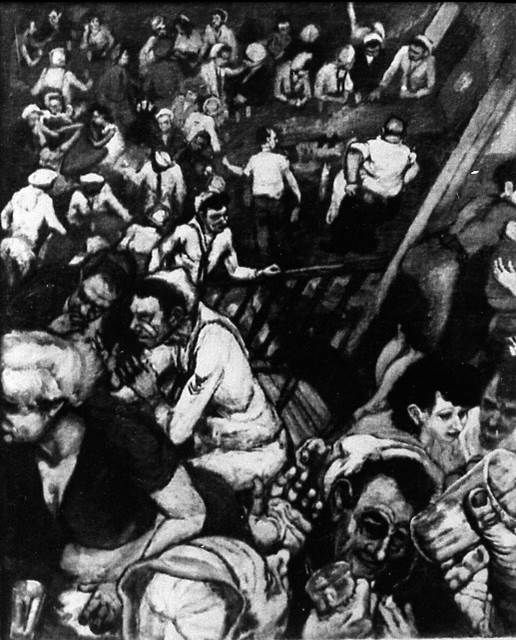
With no formal training, he first started painting the scenes he knew from the south side of Bridgeport - the rather tattered newsboys with their mongrel dog in front of an old building, and a short-order counter or bar lit up on a dark evening.
In 1938 he married Marie Roder; they remained married until his death. In 1948 they had a son whom they named John.
Mid Career
Reviewing a Riley art exhibition, art critic Martha Scott stated: "One surmises he studied drawing and anatomy at the National Academy, that he was exposed to the frescoes and gilding techniques of Florence, that he soaked up the treasures of the Uffizi Palace.... No conjecture about an artist could be more erroneous!"
A long-standing affiliation with the Silvermine Guild of Artists in New Canaan, Connecticut began when he first exhibited there in 1951. He was later elected to the Board of Trustees and was made a Guild Fellow; the organizations highest honor. By that time, Bernard Riley was established as a major artist in the area.
In 1958, Riley received national recognition through an article in American Artist magazine. In that article, Riley described his love for art: "each painting is an adventure for me. I paint solely for the joy or excitement of painting and, as we all know, enjoyment comes almost entirely from anticipation or expectancy, rather than from realization. I like to feel that as I proceed, I may encounter an open door to unknown painting possibilities. Entering these doors and exploring the territory within, feeling my way through experimentation, I am accorded the delightful thrill that comes of discovery. Thus, each painting becomes an entirely new venture, and the pattern of achievement may vary in each case.
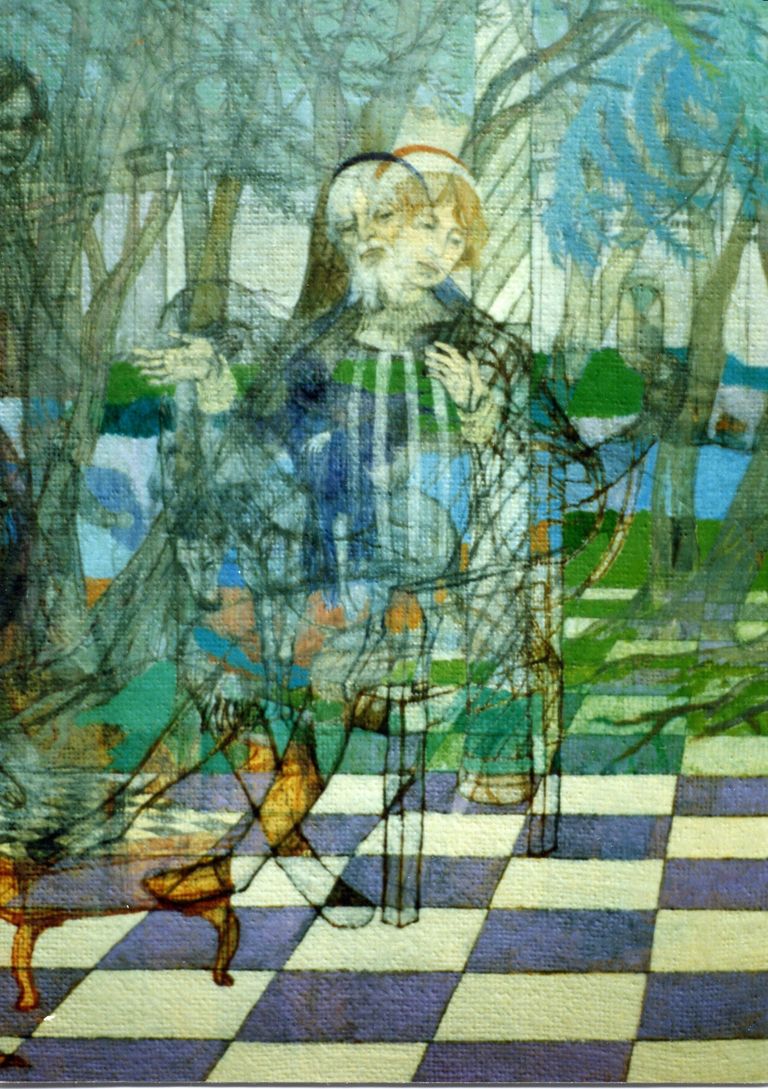
As his art matured, he developed a unique style of multiple image. He described it in this manner: "We never really see a person in static form. We remember them in a multiple image. I am attempting to show this difference in time, to get an intellectual depth rather than the depth of a draftsman. The idea of painting pictures with multiple images first came through drawing and correcting. Part of the plan is to create intrigue and excitement. Things tend to be dull when they are static.
Later Years
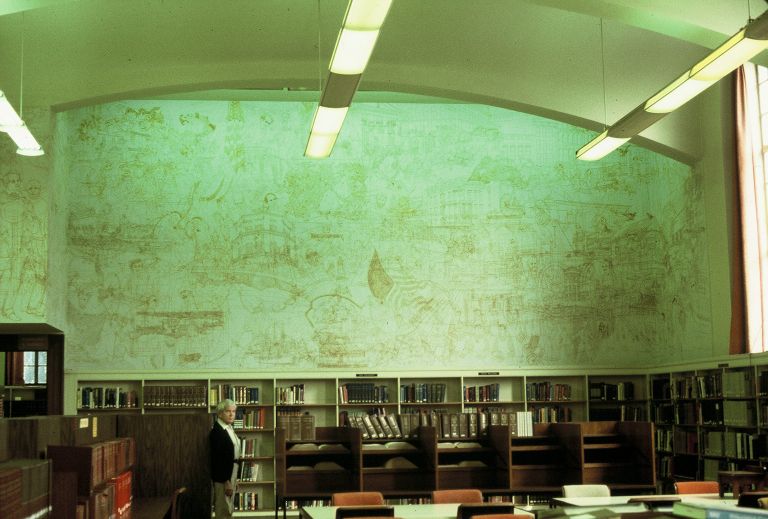
A 1975 exhibit at the Silvermine Guild of Artists featured gigantic, floor-to-ceiling drawings done with a brush. The act of drawing on a wall surface with a brush using reddish sepia is a rather outdated art technique anchored in Renaissance tradition. It becomes symbolic of the story Riley tells about the rapid disappearance of manual craftsmanship. Its bringing something new into an era that people have lost understanding of, to see someone actually doing a craft operation. They are seeing someone drawing on a wall, they wonder what can this be?
Bernard Riley's final major work, The History of Bridgeport from 1836 to 1936 is in the Bridgeport Public Library, on the wall of the Reference Room. The mural is 40 by 13 feet.
"Well, I was interested more in the character of the city than the people, rather than any heroic kind of mural; one that would show tremendous heavy industry. There was some heavy industry in Bridgeport, but actually the character of the city was more technical. It wasn't Pittsburgh, although there were smelters here and there were iron factories here. The general character of the city was more one of machinists and toolmakers and dye makers and designers. This was the truth, the strength of the city. And I wanted to show the people.
Bernard Riley died on April 12, 1984 in the city where he was born